 Vietnamnet.vn

 Podcast



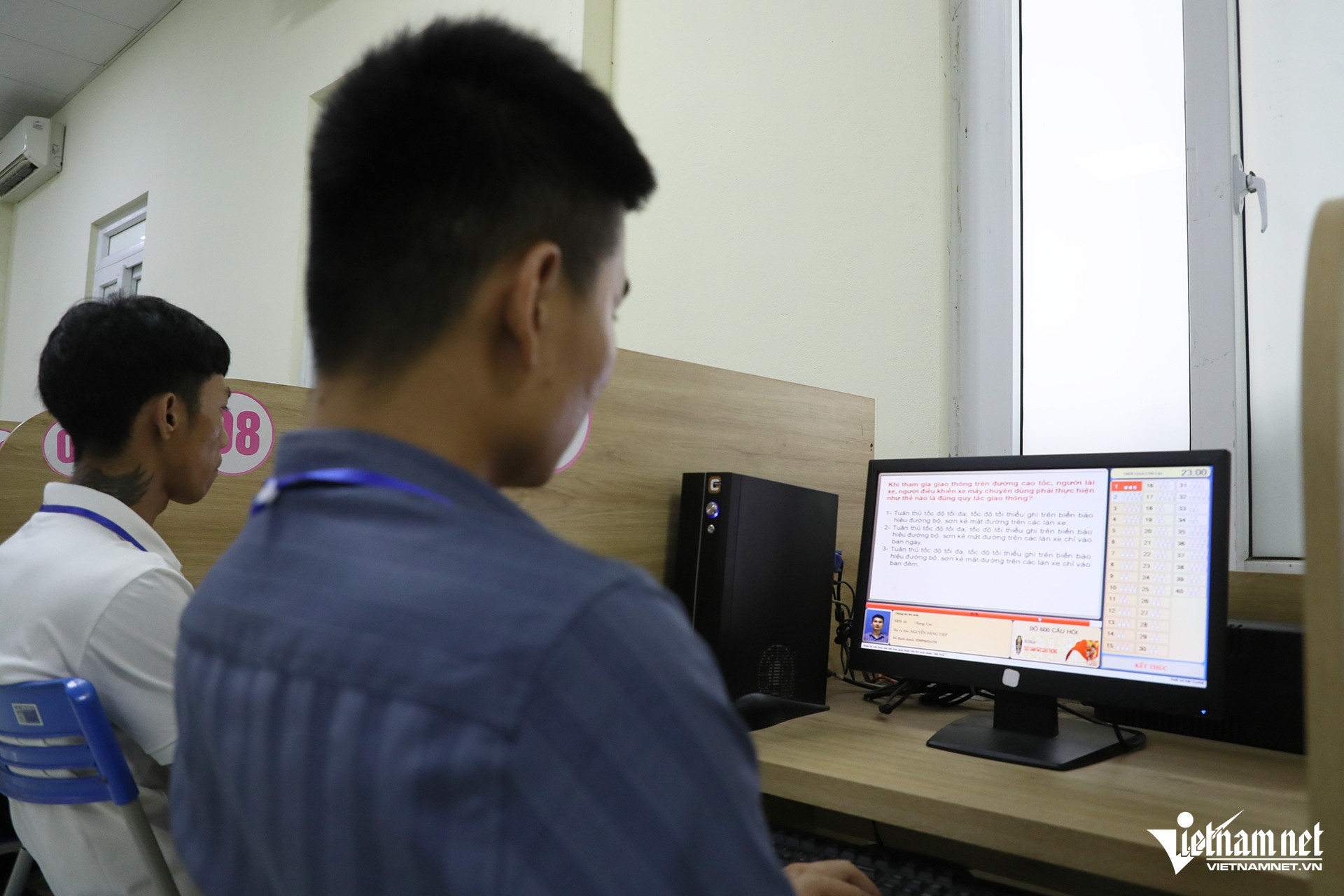
Vu Van Nam, 35, from Hanoi, complained after failing the driving test for the second time, not because of poor driving skills or ignorance of the law, but because he was 0.5 seconds late in pressing the "Space" key in the traffic situation simulation test.
This is the most difficult section and the reason why thousands of car-driving learners fail in the driving test to obtain a driver’s license. For more than two years, the simulation test featuring 120 traffic situations has become a haunting obstacle in the journey to getting a car driving license.
Recently, however, the Ministry of Public Security proposed removing the simulation test in the draft amendment to Circular 12/2025/TT-BCA, an action considered to reflect the expectations of millions of learners preparing for their driving exams.
Pressure from the ‘space’ button
Since the simulation software was officially applied on June 15, 2023, debates have been almost nonstop. Each scenario (urban roads, intersections, blind curves, motorbikes cutting in, children running into the street etc) is pre-programmed with a defined “danger point.”
Learners must detect moments of potential traffic danger by observing these simulated scenarios on the computer and respond accordingly. The required action is pressing the Space key within the “correct” time window assigned by the software, usually 0.5 to 3 seconds before the danger becomes an accident.
If pressing too early, the system interprets it as “the learner has not truly recognized the danger” and gives 0 points. If pressing too late, it considers it “slow reaction,” giving few or zero points. Only when learners hit the “golden time window” do they receive maximum points. All timing is software-defined.
With such a mechanism, the simulation test becomes a game of “pressing the key at the right moment,” which is a matter of luck; 0.5 seconds too soon or too late can cost all points and result in failure.
Nam recalled the situation that caused his failure: “When I saw a truck coming in the opposite direction and veering into my lane, my natural safe-driving reaction was to brake immediately. But the system gave me 0 points because I pressed too early compared to the programmed ‘marking point.’ I was supposed to wait until it moved into the defined frame to press.”
This has created a culture of “rote learning.” Instead of training reflexes and analytical thinking, learners must memorize “marking points” such as tree tops or signboards. Many say the test resembles a gamer challenge rather than evaluating real-world driving skills.
What do driving instructors say?
Not only are the learners struggling, but driving instructors are also in a dilemma.
Khuc Cao The, a long-time driving instructor in Hanoi, admitted that instructors like him want to focus on the skill and road test, but they have to spend time guiding learners on how to press the key at the right time.
The instructor said: "I have been teaching driving for nearly 20 years, and I have never seen learners so confused by a computer simulation test section as they are now. In some situations, if you slow down from afar for safety, as you would do in real life, the software marks it as 0 points."
According to The, sometimes the failure rate due to the simulation test reached 30 to 40 percent, causing major waste of time and money, while the actual improvement in driving skills remains unproven.
“In real life, when there is danger, the driver slows down immediately. But doing that in the simulation results in failing. This trains learners to respond late to dangerous situations, which is unsafe,” The said.
Changes expected
After strong public reaction, the Traffic Police Department said it had collected feedback and proposed removing the simulation test in the draft amendment to Circular 12/2025.
Experts say simulation should only support training, not determine whether someone passes or fails. Rigid scoring and overreliance on software logic lead to inaccurate assessments.
The believes hazard recognition can be strengthened in the on-road driving test, where candidates face real, dynamic situations far more meaningful than any video.
As soon as news of the proposal to remove the simulation test was released, car and motorbike forums heated up, and most people expressed relief.
Dinh Hieu
.svg)
