 Vietnamnet.vn

 Podcast



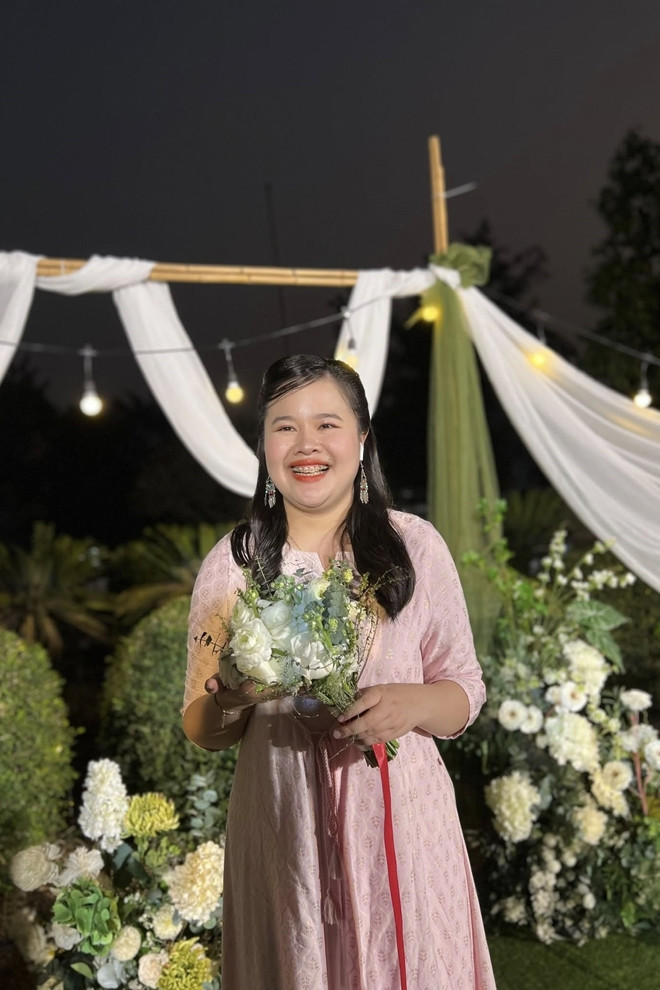
Can you tell us about your journey to becoming the first-ever visually impaired host in VTV's history?
I’ve had a connection with journalism since I was young. As an interviewee, I would observe how reporters and program makers worked. At secondary school, I was given the opportunity to participate in children's radio programs by the Voice of Vietnam. Back then, we didn’t have assistive tools. I would conduct interviews, memorize everything, then go home and recite it to my mother who wrote it down and submitted it to the newspaper.
I had always wished to be a bridge between people with and without disabilities. People with disabilities are often portrayed as two extremes, either as heroes or as tragic figures. In reality, we live happily, joyfully, and rarely see disability as something that brings sadness or pity.
In university, I practiced by watching TV and imagining myself as a host. At that time, I didn’t think I’d ever get an actual opportunity, I was just preparing myself.
When I received an invitation from Ngoc Bich (VTV4) to host the show “Life is still beautiful’, it was a surprise, but I was ready.
Being a visually impaired MC requires unique skills and approaches compared to typical MCs. Are there any memorable incidents or humorous moments?
Recently, we filmed a program about emergency escape and first aid skills. The team asked me to act out scenes for visual illustration before adding graphics.
This was a big challenge for visually impaired people. Using body language and facial expressions required a lot of training.
Senior hosts guided me hand-in-hand on how to move in ways that matched the content. I also consulted makeup staff about application techniques. Whatever other hosts can do, I have to be able to do too.
It might look funny on air, but I tried my best. Each program helps me discover new abilities.

As a host, you must have met many people with unusual life stories. Which one touched you the most?
After Typhoon Yagi, we did a program on a cooperative in northern Vietnam that employed people with disabilities to make wooden products.
When we arrived, the storm had just passed and everything was in ruins. The machinery was water-damaged, and all the wood and products were destroyed. The workers didn’t have money to repair or replace equipment, so they just sat and waited.
Despite the devastation, I felt their deep desire to work and contribute. That’s a trait of people with disabilities, a strong will to overcome any obstacle. That was the most unforgettable moment for me.
You likely haven’t always been strong and optimistic. What was the hardest phase in your life and how did you get through it?
The hardest thing was education. I loved going to school, but in Vietnam, there are few schools for children with disabilities. I was lucky to be in Hanoi, where there’s Nguyen Dinh Chieu school for the blind, but it only goes up to secondary school.
Finding a high school and university was extremely difficult. Very few blind students get to attend university. I had to find a place willing to accept me and prove to teachers that, although being blind, I could absorb knowledge and study independently without needing any curriculum changes.
There were times I felt lost, unsure of what to do or where to go. But from a young age, I had the goal of becoming a psychologist to help parents and children break down barriers and create opportunities for all Vietnamese children with disabilities to go to school.
That goal kept me going. I was fortunate to receive support from the education sector, teachers, friends, and family.
How were your parents able to raise a child in a time when society was not yet open to people with disabilities?
What’s special about my parents is that they always believed I could do it. From a young age, the phrase I heard the most was: “We believe you can do it, as long as you try.”
They never built mental barriers. They didn’t say “You’re blind, so you’re unfortunate,” or “This is as far as you can go.” If I wanted to go to school, they helped me find a place to study. If I wanted to be a host, they became my audience. That was my solid foundation. Before I believed in myself, they believed in me.
Huy Minh
.svg)
