 Vietnamnet.vn

 Podcast



As floodwaters recede, flower and ornamental plant growers in Vi Khe ward, Ninh Binh province, are working relentlessly to clean up and revive their farms in hopes of meeting market demand for the Tet holiday.

Floodwaters severely damaged ornamental plant gardens along the dikes.
Due to the impact of tropical storms No. 10 and 11, prolonged heavy rains combined with upstream runoff caused river levels across Ninh Binh to surge, flooding many riverside areas.
In Vi Khe, rising waters from the Hong and Dao rivers submerged over 43 hectares of flower and ornamental plant fields located outside the dikes, inflicting severe damage on local farmers.
Vu Thi Hanh, a resident of Vi Khe, shared that her family grew short-cycle ornamental plants such as golden chain trees, colorful foliage, and globe amaranth on two sào (roughly 720 square meters) of land beyond the Hong River dike.
“The flood came so fast I couldn’t save anything,” she said. “Months of effort washed away overnight. Last year, we lost over 100 million VND (about 4,100 USD), and this year, just as the plants were nearly ready for sale, it happened again. I couldn’t sleep for days.”
Nguyen Thi Hang, also from Vi Khe, was in a similar situation.
Her five sào (about 1,800 square meters) of short-cycle ornamental plants were completely submerged.
Staring at her ruined garden, she sighed, “The damage is overwhelming, but what can we do against nature? Every household around here suffered - some lost tens of millions, others hundreds of millions of dong.”

Withered potted plants scattered across the flooded fields.
Vi Khe is famed for its flower and ornamental plant trade, a tradition passed down through generations for hundreds of years.
Currently, over 95% of households in the ward are involved in this craft, which provides a stable livelihood and economic foundation.
Its products include everything from peach blossoms and kumquats to artistic bonsai and landscape trees.
Over time, Vi Khe’s customer base has expanded nationwide, solidifying its reputation as one of northern Vietnam’s premier ornamental plant villages.
As soon as the floodwaters began to recede, local authorities quickly mobilized efforts to help farmers resume production.
Now, on the alluvial plains along the riverbanks, Vi Khe’s residents are busy cleaning up, restoring their soil, and trying to sow new crops in time for Tet.
After a few days of devastation, Hanh reminded herself, “As long as we’re still here, we can rebuild.”
She began clearing out damaged plants and preparing the soil to plant again.
With seedlings in short supply and prices skyrocketing after the floods, she had to borrow money to restart her nursery.
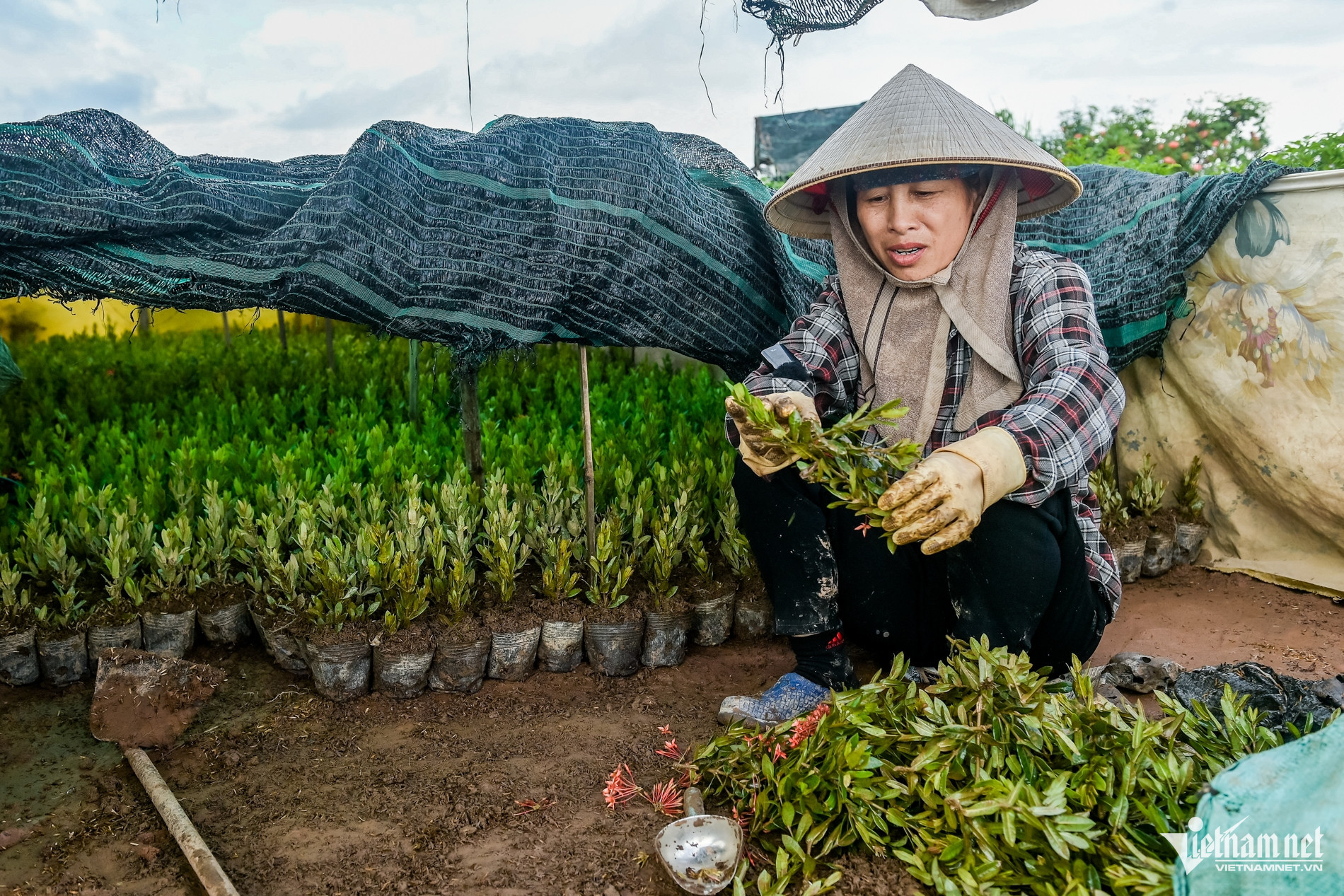
“My family specializes in growing decorative border plants used for gardens, construction sites, parks, and streets,” she explained.
“These plants are short-cycle, but still require four to six months to mature. If the weather is favorable and we can replant right away, we may still catch the Tet market.”
Nearby, Nguyen Thi Thom was also working hard to sanitize her flooded land and replant.
“Our three sào of short-cycle ornamental plants were completely underwater,” she said.
“I’ve been making use of the clear days to remove the dead plants and till the soil, trying to replant as fast as possible so we’ll have something to sell for Tet.”
Despite the hardship, the people of Vi Khe are determined to bring their gardens back to life.
Each freshly planted plot represents hope for a bountiful Tet after the devastation of natural disaster.
Trong Tung
.svg)
