 Vietnamnet.vn

 Podcast



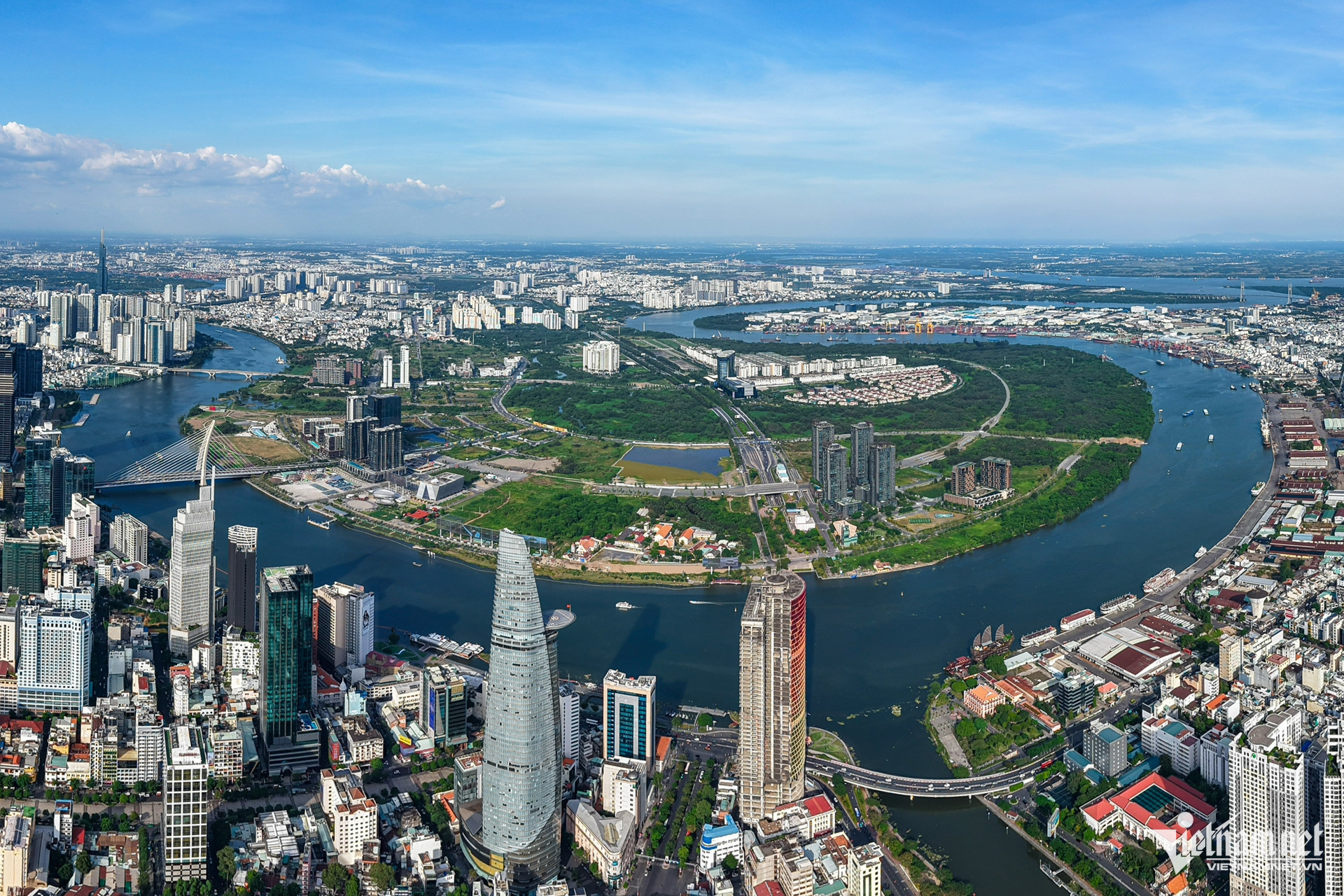
The city's economic structure continues to shift positively.
The services sector accounted for 51.6% of GRDP, while industry and construction contributed 35.6%, agriculture - forestry - fishery made up 1.7%, and the remaining 11.1% came from product taxes minus subsidies.
The service sector remains the primary growth engine, expanding by 8.59% and contributing over 61% to overall GRDP growth.
Among nine core service industries, the average growth was 8.18%, with accommodation and food services surging by 11.73%, reflecting a strong recovery in tourism and domestic consumption.
Retail trade grew 7.56%, while e-commerce soared by 11.01%, fueling logistics and transport demand.
Finance and banking rose by 6.97%, and real estate saw a modest recovery of 3.24%.
The industry - construction sector grew by 5.35%, accounting for 28.1% of GRDP growth.
Manufacturing expanded by 7.55%, and construction surged by 8.57% - clear signs that public investment disbursement has started to impact production.
Total social investment capital in the first nine months reached VND 465.05 trillion (approx. USD 19.15 billion), up 10.3% year-on-year.
State capital rose sharply by 43.5%, making up 27.7% of the total investment.
Public investment from the city’s budget reached VND 87.79 trillion (approx. USD 3.62 billion), an increase of 50.6%, fulfilling 57.5% of the annual plan.
Major infrastructure projects - including Ring Road 3, the Ho Chi Minh City - Moc Bai Expressway, Metro Line 2, and the Tham Luong - Ben Cat - Nuoc Len canal - are entering accelerated construction phases.
Ho Chi Minh City’s stock exchange (HOSE) also saw a 29.7% increase in liquidity in August, with the VN-Index surpassing 1,680 points.
Market capitalization reached VND 7.2 quadrillion (approx. USD 296.3 billion), equivalent to 2.2 times the city’s post-merger GRDP.
Budget revenue rises while development spending doubles
Total state budget revenue in the city reached VND 570.56 trillion (approx. USD 23.47 billion) in the first nine months - 81.8% of the annual target and up 15.6% from the same period last year.
Domestic revenue accounted for 71% of total revenue, rising 22.8%.
Personal income tax collections increased by 20.3%, and revenue from property-related taxes surged 3.6 times year-on-year.
Conversely, local budget expenditure was estimated at VND 143.6 trillion (approx. USD 5.9 billion), up 72.7%.
Development investment spending hit VND 62.75 trillion (approx. USD 2.58 billion), more than doubling from the previous year - a clear signal of strong infrastructure and demand stimulus.
Retail sales of goods and services reached VND 1.403 quadrillion (approx. USD 57.7 billion), up 15.3% year-on-year.
Revenue from accommodation and food services was VND 166.64 trillion (approx. USD 6.85 billion), rising 25.4%.
Tourism services earned VND 38.53 trillion (approx. USD 1.58 billion), up 27.4%.
Other services - including real estate, education, healthcare, and entertainment - generated VND 475.71 trillion (approx. USD 19.56 billion), a 12% increase.
Consumer goods categories all recorded growth: food sales rose 19.5%, household items 24.7%, and educational materials 29.4%, reaffirming that domestic consumption remains a key pillar of growth.
The consumer price index (CPI) rose 0.3% in September compared to the previous month and 4.01% year-on-year.
The average CPI for the first nine months increased by 4.06%.
The education group rose 1.78%, healthcare surged 15.46%, and food and beverage increased slightly by 0.33%.
In contrast, transport and telecommunications prices declined by 1.42% and 0.97% respectively, helping stabilize overall inflation.
Gold prices spiked 57.86%, and the USD exchange rate rose 6.42%, reflecting global economic pressure - but these have yet to significantly affect domestic consumption.
Overall, Ho Chi Minh City is showing solid recovery momentum.
Each quarter's GRDP has outpaced the previous one, public investment is accelerating, consumer demand is growing, and inflation is under control.
The city is building a solid foundation to sprint into Q4, aiming for annual growth exceeding 7%.
For Q4/2025, the city has identified three strategic directions: finalizing spatial planning and regional connectivity; accelerating public investment disbursement with a focus on critical infrastructure; and developing services, the digital economy, and green economy - reinforcing its role as a national growth driver.
Quoc Ngoc
.svg)
