 Vietnamnet.vn

 Podcast



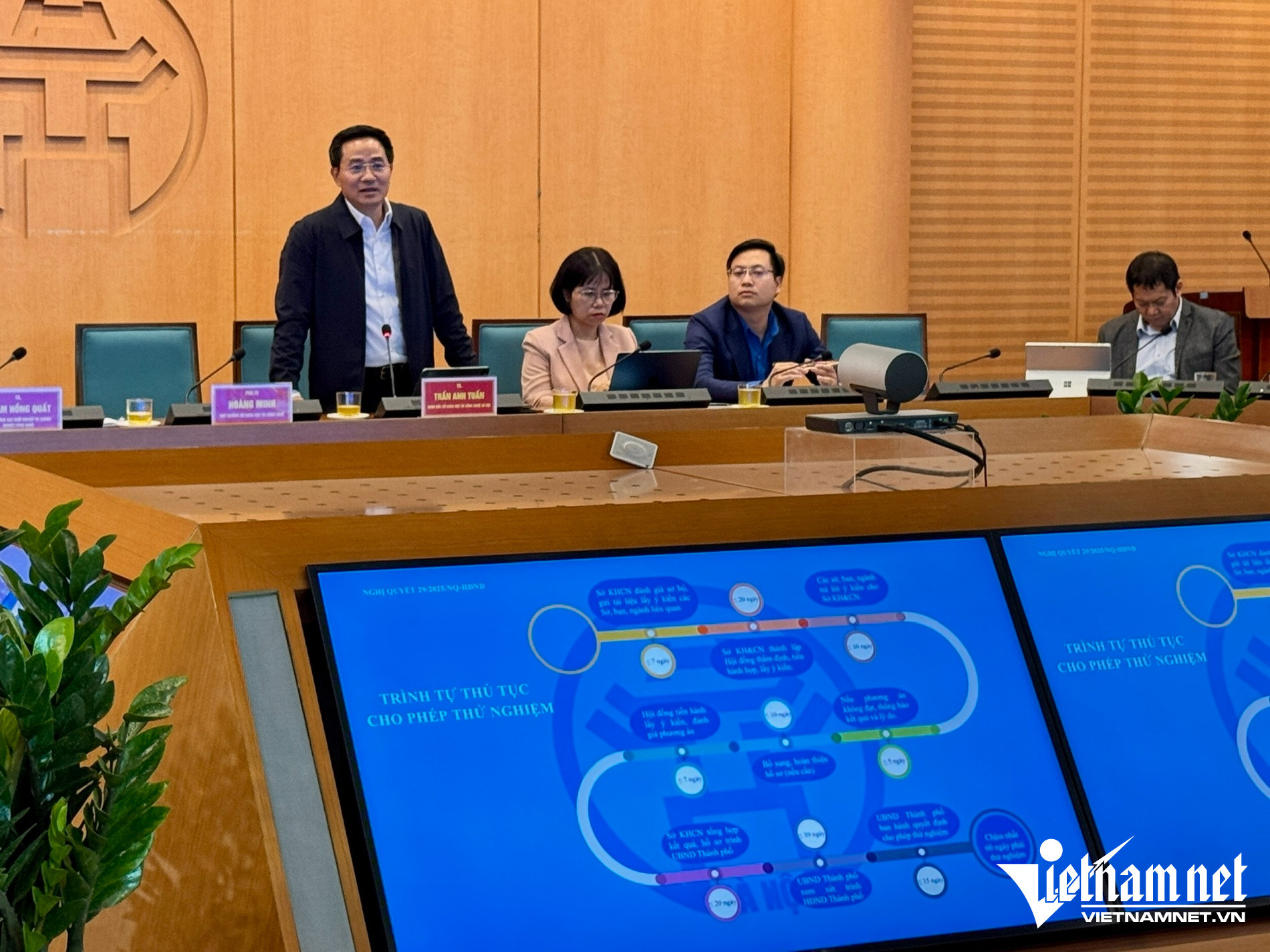
He shared the information at a conference in Hanoi on October 23 on Government Decree No 271/2025/ND-CP, which regulates the establishment, the participation in the establishment, and capital contributions to spin-off enterprises for the commercialization of scientific research and technological development results.
The event was organized by the Hanoi People’s Committee in collaboration with the Ministry of Science and Technology (MOST).
According to the director, along with the city’s six existing resolutions on the development of science, technology, and innovation, Decree 271 helps complete a closed-loop chain (ordering – research – reimbursement – commercialization – sandbox), aiming to form spin-off enterprises from universities within this year.
Earlier, in his opening remarks, Deputy Minister of MOST Hoang Minh noted that Decree 271 has “broken down barriers” to link science, technology, and everyday life.
He emphasized that the resolution represents an “institutional breakthrough,” realizing the Party’s and the National Assembly’s resolutions to closely connect scientists, research institutes, and universities with society.
“Decree 271 is both an expectation and a task for Hanoi to implement effectively, achieving scale and quality in university spin-offs,” Deputy Minister Hoang Minh said.
Clarifying further, Pham Hong Quat, Director of the Startup and Technology Enterprise Department, said Decree 271 aims to provide superior policies and set a legal corridor for public higher education institutions, public vocational education institutions, and other public science and technology organizations in Hanoi to establish, participate in establishing, or contribute capital to enterprises for commercializing scientific research results and technology development under their intellectual property ownership.
Decree includes 5 chapters and 18 articles, applying to entities headquartered in Hanoi with scientific research and technology development results under their intellectual property ownership, public employees at the above institutions, and related organizations and individuals.
Unlike Decree 263 (which guides certain provisions of the Law on Science, Technology, and Innovation related to autonomy mechanisms, accountability, human resources, talent, and awards in science, technology, and innovation), Decree 271 clearly defines the authority and process for valuing intellectual property and research results for capital contribution and commercialization. The decision-making authority rests with university councils or management boards, or with the head of the institution where such councils are not established.
Another new feature concerns financial resources: capital may come from institutional operating funds, science and technology development funds, or lawful donations and sponsorships intended for capital contribution.
Improving university–enterprise cooperation
With these new provisions, delegates at the conference agreed that Decree 271 provides an essential legal corridor to remove long-standing obstacles in cooperation between universities and enterprises.
Associate Prof Dao Ngoc Tien, Vice Rector of Foreign Trade University, said that unlike other technical universities, his university lacks patents or inventions to contribute as capital but has strong brand value and human resources. He said the Decree “unlocks” two key issues: brand valuation and the appointment of university officials to manage spin-off enterprises.
Meanwhile, Associate Prof Huynh Dang Chinh, Vice President of Hanoi University of Science and Technology, stressed the need to “take full advantage of this excellent legal framework.”
He said the university owns a large number of patents and will soon pilot four sectors and five research groups with intellectual property assets. The school already operates several internal spin-offs and will review them to meet the new criteria.
Representatives of other educational institutions expressed hopes for support from MOST and the Hanoi Department of Science and Technology in research and product licensing procedures to avoid resource waste due to process errors.
Tran Nam Tu, Deputy Director of the Department of Science, Technology, and Information (Ministry of Education and Training), observed that bringing research products to market remains a major challenge, while demand for establishing spin-off enterprises in universities is high.
He proposed that MOST and the Hanoi government authorize several pioneering universities to establish spin-offs, encouraging institutions to choose their own models, whether by capital contribution, joint establishment, or independent creation.
Tran Anh Tuan said Hanoi will commission some universities and institutes, providing financial support on a case-by-case basis. “The city has committed to allocate 4 percent of its annual regular budget to science and technology, equivalent to about VND5,000 billion,” he noted.
In addition, an interagency task force will be established to implement Decree 271, operating both online and offline to guide pilot spin-off formation by universities and institutes. “We aim to have the first spin-offs launched by November or December,” he said.
Du Lam
.svg)
