 Vietnamnet.vn

 Podcast



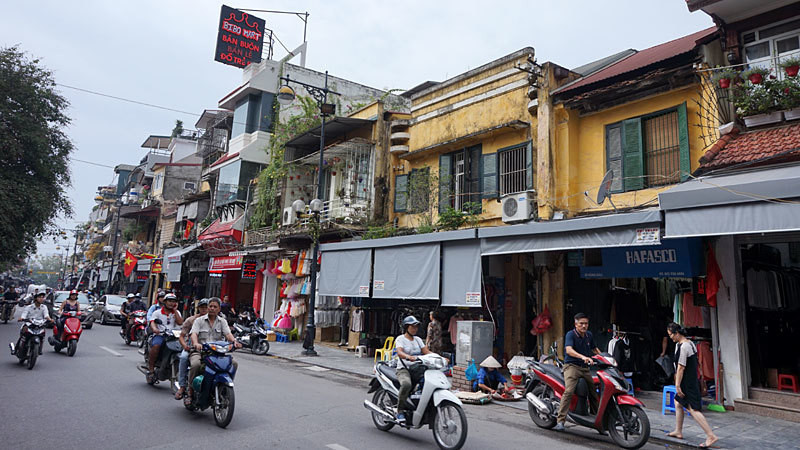
With such sky-high prices, the question is: who is actually buying?
Street-front house prices exceed VND1 billion/sqm
Hanoi’s real estate market is witnessing an unprecedented trend, with property prices along many central streets now surpassing VND1 billion per sqm. Market surveys show that on streets like Hang Ga, Cau Go, Hang Bong, Hang Ngang, Hang Duong, and Ha Trung, shophouses are being listed for well above VND1 billion per sqm.
On Hang Buom street, a shophouse of 101 sqm, 8 stories high, is quoted at VND130 billion, equivalent to about VND1.29 billion per sqm. Located on one of the busiest commercial streets in the old quarter, the property currently operates as a hotel and service store, which contributes to its high valuation.
On Cau Go street, another 8-story house with 100 sqm of space is being offered at VND118 billion, or VND1.18 billion per sqm. The steep price is justified by its operation as a hotel in a bustling area filled with international visitors and commercial activity.
Most notably, a property on Hang Bong is listed at VND777 billion for 370 sqm, equivalent to over VND2.1 billion per sqm. This large corner-lot building is ideally located for commercial use or redevelopment, which has pushed its asking price to a record level.
In 2018-2019, houses in the old quarter of Hanoi typically ranged from VND400-700 million per sqm, while the prices have now doubled or even tripled in some areas like Hang Bong, Hang Buom, or Hang Gai. This growth rate rivals or surpasses that of many major cities in Southeast Asia.
Not just the old quarter, but other major commercial roads such as Xa Dan, Huynh Thuc Khang, Lang Ha, Thai Ha, and Chua Boc are also recording listing prices near or above VND1 billion per sqm. For instance, a 2-frontage house of 85 sqm on Huynh Thuc Khang is listed at VND115 billion, roughly VND1.35 billion per sqm.
On Lang Ha, a 100 sqm corner-lot property is listed at VND105 billion, or VND1.05 billion per sqm. On Thai Ha, an 88 sqm house is going for VND105 billion, or VND1.19 billion per sqm. Meanwhile, listings on Chua Boc range from VND1.1 to 1.5 billion per sqm.
Similarly, townhouses near West Lake also reach the VND1 billion/sqm threshold, sometimes higher than some old quarter areas. Some lots on Quang An or Yen Phu roads are listed from 90-120 billion VND for 80-100 sqm.
High prices, low liquidity
According to Nguyen Dung Minh, a real estate expert, one core reason Hanoi property prices have crossed the VND1 billion per sqm threshold is the extreme scarcity of urban core land. Streets reaching these prices are mainly in the old quarter or around Hoan Kiem Lake, the areas with virtually no room for expansion. This makes supply extremely limited and pushes the value of each square meter to record highs.
Beyond scarcity, these shophouses hold significant commercial value. Properties on central streets offer more than just a place to live, they are “money making machines” through business operations, service rentals, or retail premises.
Rental income can reach hundreds of millions of dong per month, creating stable and long-term cash flow. Amid inflation and financial market fluctuations, prime-location shophouses have become a “safe haven” asset that investors are eager to hoard.
Additionally, market expectations and price anchoring effect (once a high price is set or announced, it becomes a reference point, influencing perceptions and expectations, causing subsequent prices to be evaluated relative to that anchor, often pushing the overall price level higher) also contribute to pushing price levels higher. The mindset of "scarcer land, higher prices must be" continually reinforces central price floors, regardless of broader market slowdowns.
However, Minh notes that liquidity in this segment is extremely low. At prices of hundreds of billions of VND per property, the number of investors with sufficient financial capacity for actual transactions is very small.
Most listings are currently just “testing the market,” while real deals can take months, or even years, to finalize. This makes the “billion-per-sqm” segment virtually inaccessible to the majority of investors, reducing overall market flexibility.
Hong Khanh
.svg)
