 Vietnamnet.vn

 Podcast



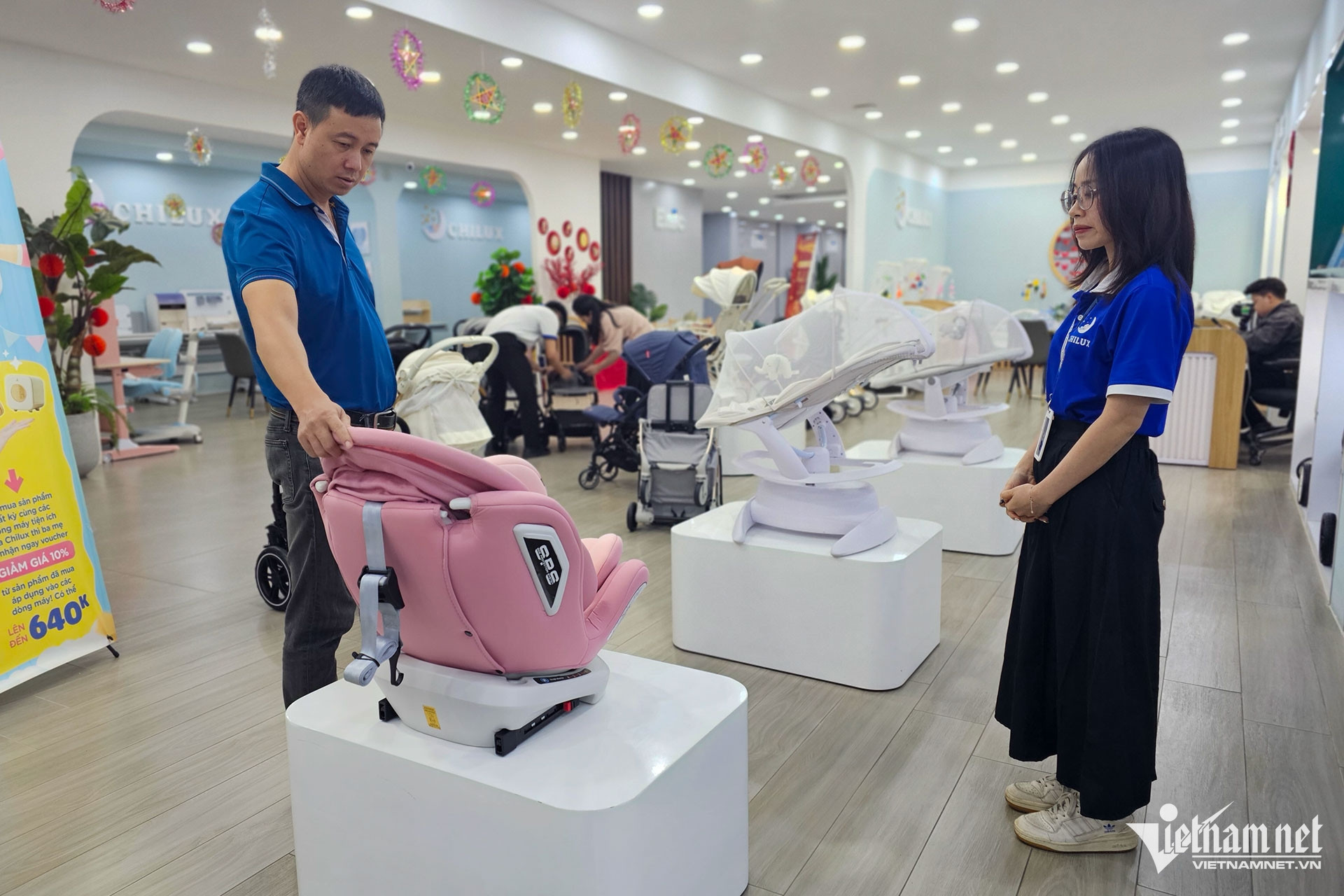
Buyers are lost in a price "matrix," where a lack of understanding can lead to wrong choices.
Clause 3, Article 10 of the 2024 Law on Road Traffic Order and Safety clearly stipulates: from January 1, 2026, children under 10 years old and under 1.35 meters in height are not allowed to sit in the same row as the driver, except when the vehicle has only one row of seats.
The driver must use or give instructions on the use of appropriate safety restraints for children. Violations will be fined from VND800,000 to VND1 million according to Decree 168/2024/ND-CP.
This is a major step forward in raising traffic safety standards. But as the effective date approaches, choosing an appropriate car seat has become a pressure point for parents. The market is heating up, and users are overwhelmed by price differences and quality concerns.
Demand rises
Just a few years ago, car seats mainly targeted well-off customers familiar with safety culture. But the demand has surged unexpectedly..
According to VietNamNet’s findings, the number of people researching and buying child car seats at many mom-and-baby stores in Hanoi has increased several times compared to last year. Most customers are families with young children within the regulated age and height range.
A sales consultant at the Chilux baby product showroom on Xa Dan Street, Hanoi, said sales of child car seats in the last three months have increased 2–3 times.
Bich Hang, the owner of a baby product shop in Cau Giay, said: “We used to display car seats, but few people cared so we stopped selling them. In the last two months, demand has risen sharply, so we are planning to restock.”
Rising demand has triggered a supply race. Vietnam’s child car seat market now features many well-known global brands such as Joie, Chilux, Chicco, Maxi-Cosi and Zaracos, officially distributed with warranties and certified to meet ECE R44/04 or R129 (i-Size) standards. Prices typically range from VND2 million to VND7 million, while high-end models cost tens of millions of dong.
Alongside officially distributed products, used seats are also available, often Japanese, Korean or European domestic models. Their quality may be good, but they lack warranty and are difficult to verify. Prices range from VND1.7 million to VND1.9 million.
However, the “fever” also brings risks. Many uncertified or untested seats have begun appearing on e-commerce platforms for less than VND1 million.
“We sellers are worried, but the biggest worry is that customers might buy low-quality seats. If something happens, the consequences are unpredictable,” Hang said.
Users now desperate for information
Previously, many Vietnamese parents preferred holding their children or letting them sit freely in the back seat. Now, the mandatory requirement has created a psychological jolt.
Le Manh Linh, admin of the “Anh Em Me Xe” forum, said: “When our family welcomed a new member, I invested in a child seat worth more than VND10 million for our Ford Ranger Raptor even before any mandate. Car seats are costly but worth it, comfortable for kids and easy to install.”
Lan Anh (Nam Tu Liem, Hanoi), the owner of a Mazda CX-5, admitted: “I knew child car seats are safer, but I ignored them because I thought traffic speed here is not high. Now that the law requires it, I’m rushing to research, but it’s too confusing.”
On online forums and car groups, discussions about child car seats are the hottest topics. Parents exchange advice frantically. Many admitted that they always knew car seats were necessary but postponed buying until the law forced them to act.
What parents should consider
While many parents are careful when seeking to buy seats, others fall into the trap of buying cheap seats with no ECE R44/04 or R129 certification, just to “comply” when encountering traffic police. This is a common mistake, as the core purpose is protecting the child’s safety.
Linh Trang
.svg)
