 Vietnamnet.vn

 Podcast



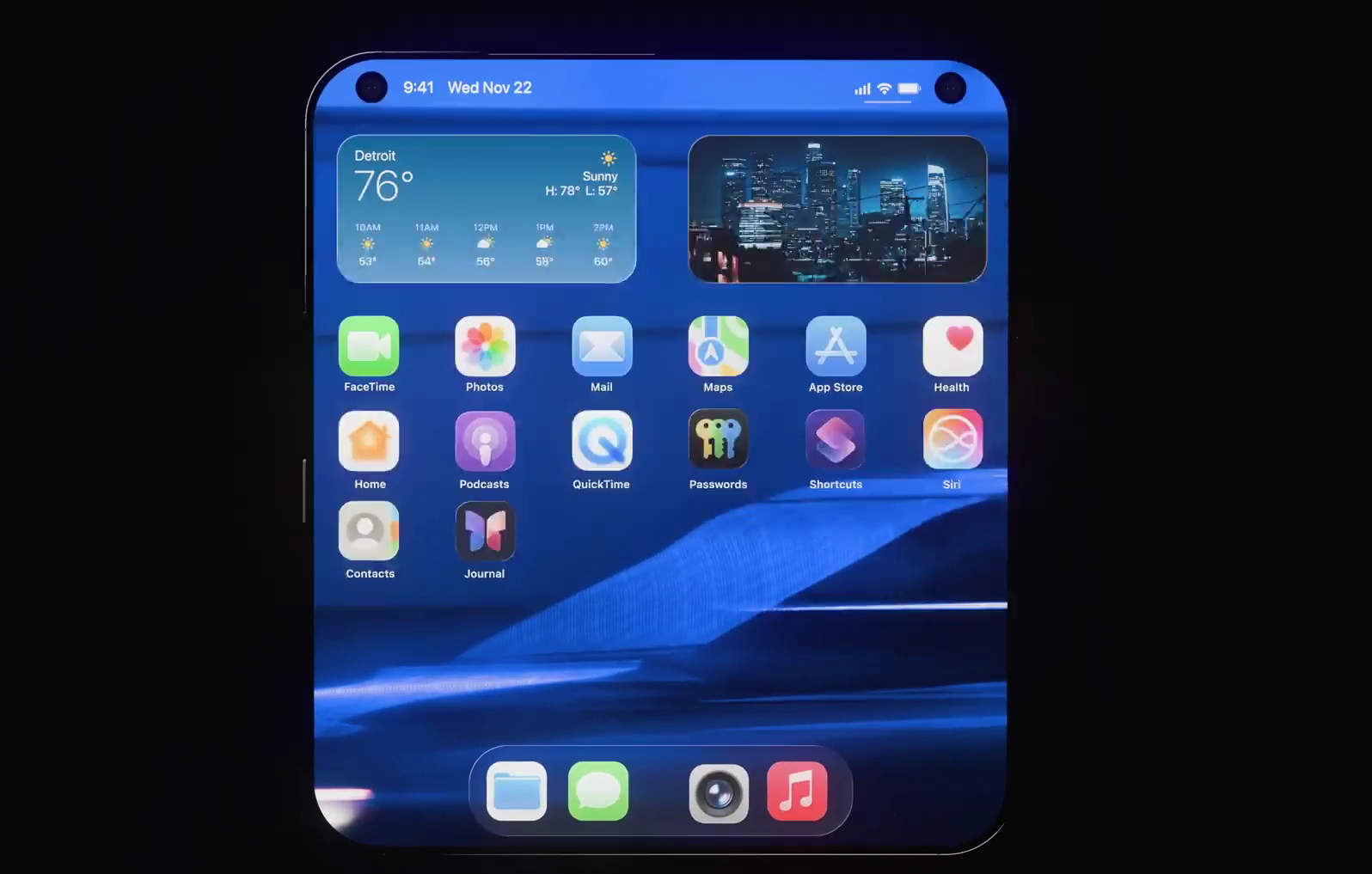
After years of staying out of the foldable smartphone market, Apple now appears poised to join the fierce competition dominated by Samsung, Google, and several Chinese manufacturers.
According to recent leaks, Apple’s first foldable iPhone – dubbed the iPhone Fold – could launch alongside the iPhone 18 lineup in 2026. If true, this would mark Apple’s most significant product evolution since the debut of the iPhone X.
When will the foldable iPhone launch?
While the original projection pointed to a 2026 launch, some reports now suggest Apple is facing production challenges that could delay the debut until 2027.
However, given Apple’s reputation for prioritizing design precision and quality, a delay to refine the device would not be surprising.
For now, 2026 remains the most likely launch window.
Book-style design inspired by Galaxy Z Fold
Leaks suggest Apple will opt for a book-style folding design - similar to Samsung’s Galaxy Z Fold or Google’s Pixel Fold - rather than the clamshell style seen in the Galaxy Z Flip.
This means the foldable iPhone will function like a regular smartphone when closed and transform into a larger screen, akin to an iPad mini, when unfolded.
The folded thickness is expected to be around 9–9.5mm, and just 4.5–4.8mm when open.
With every millimeter mattering in the ultra-slim race, Apple is reportedly aiming to produce the thinnest foldable phone on the market.
Two displays: a 7.8-inch main screen and a 5.5-inch cover screen
The device is expected to feature two displays: a 7.8-inch primary internal screen and a 5.5-inch external cover screen.
The latter is roughly the size of the iPhone 13 mini’s display, appealing to fans of compact phones.
Interestingly, both screens may adopt wider and shorter aspect ratios than current foldable models, enhancing the tablet-like experience and moving away from the long, narrow layouts of existing devices like the Galaxy Fold.
Familiar camera setup optimized for foldable use
Apple is expected to retain the 48MP dual-camera setup found in the standard iPhone 17, avoiding the multi-lens race with competitors.
What stands out, however, is the selfie camera system: one under-display camera for the inner screen and a punch-hole camera on the outer screen.
The under-display sensor allows for a seamless internal interface, creating the illusion of an all-screen iPad mini.
Touch ID comeback – the biggest surprise
One of the most talked-about potential changes is the return of Touch ID.
To optimize internal space for the foldable form, Apple is rumored to drop Face ID in favor of a side-mounted Touch ID power button, similar to the iPad Air and iPad mini.
This would mark the return of Touch ID to Apple’s premium phones after several years of absence.
Apple’s C2 modem – total 5G independence
The foldable iPhone is expected to use Apple’s in-house C2 modem, the successor to the C1 and C1X chips.
This move signals Apple’s push to eliminate reliance on Qualcomm and control both hardware and software integration for better battery life and performance.
Incorporating its own modem would be a strategic leap in Apple’s path toward technological self-sufficiency.
A20 chip: Apple’s biggest leap in performance in years
The foldable iPhone is likely to be powered by the A20 chip, produced on a 2nm process.
This new processor is expected to deliver a 15% performance boost and 30% better power efficiency compared to the A19 (3nm), making it a landmark chip for Apple’s transition to foldables.
12GB RAM, up to 1TB storage
Rumored specs include 12GB of RAM and storage options of 256GB, 512GB, and 1TB.
This would be the most powerful configuration ever offered on an iPhone - fitting for a multitasking foldable device.
Price: A premium flagship at $2,000
Leaks indicate a target price of around $2,000, positioning the foldable iPhone as one of the priciest smartphones on the market, in the same league as the Galaxy Z Fold 7.
Despite the steep price tag, Apple is betting on superior design and optimized software to appeal to high-end consumers.
Biggest battery ever in an iPhone: 5,000–5,500mAh
The device is expected to feature a battery between 5,000 and 5,500mAh - the largest ever in an iPhone.
The real challenge, however, lies in fitting such a large battery into a foldable frame without compromising thinness or increasing weight.
Apple must address this puzzle before mass production.
Based on current information, Apple doesn’t seem to be aiming for the most radical foldable on the market, but rather a well-rounded, durable, and user-friendly device.
This aligns with Apple’s philosophy: not to be the first, but to be the best.
The foldable iPhone is more real than ever. While it may not make headlines immediately, Apple’s focus on refinement and quality could establish this device as the foundation for a new generation of iPhones - where phones and tablets converge.
Now, users have just one thing to do: wait a little longer, as Apple appears more ready than ever.
Hai Phong
.svg)
