 Vietnamnet.vn

 Podcast



Nestled within a cave on a high mountain in Ninh Binh, the over-1,000-year-old Bai Dinh ancient pagoda - dedicated to Buddha and Mother Goddesses - remains cloaked in mystery and spiritual significance.

To reach the ancient Bai Dinh Pagoda on Dinh Mountain (Ninh Binh), visitors must climb more than 300 stone steps from the three-entrance gate halfway up the mountain.
Unlike grand pagodas with towering columns and elaborate sanctuaries, the original Bai Dinh Pagoda follows the ancient style of cave temples, simple yet solemn and mysterious in its atmosphere.
Founded in 1136 by Zen Master Nguyen Minh Khong, the pagoda consists of two main sections: the Bright Cave on the right, which worships Buddha and local deities, and the Dark Cave on the left, dedicated to the Mother Goddesses.
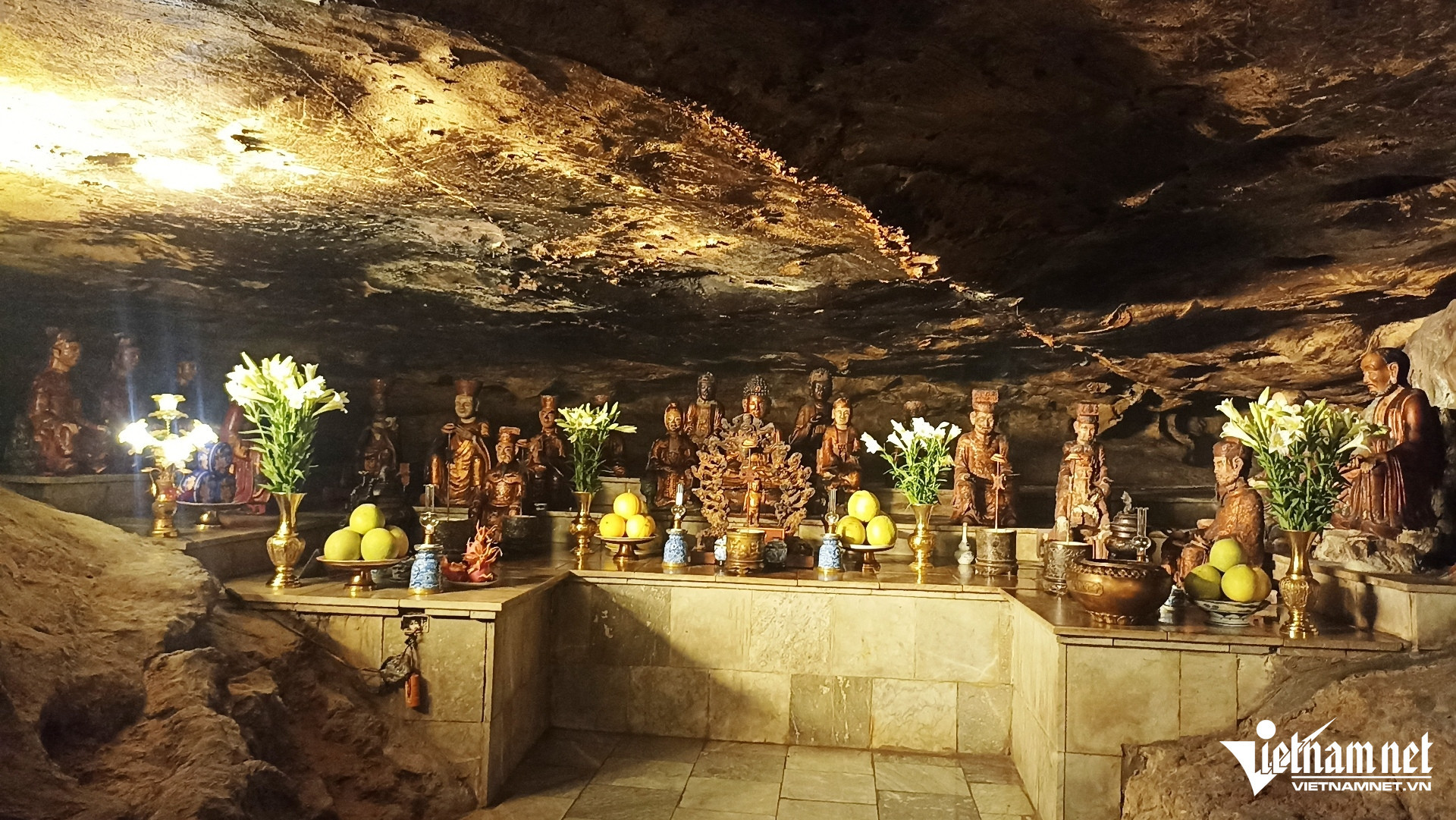
Each cave is associated with unique legends and spiritual tales, adding to the site’s sacred and mystical aura. All altars for Buddha and the Goddesses are set deep within the natural stone caverns.

Legend has it that Zen Master Nguyen Minh Khong discovered the site while gathering medicinal herbs in the mountains to treat King Ly Than Tong, who was afflicted with a condition believed to transform him into a tiger.
Within the cave, he established a small shrine to worship Buddha, which became known as the Bright Cave, or Bai Dinh Pagoda.
The Bright Cave extends about 25 meters in length, stands over 2 meters high, and spans 5 meters in width. It is a completely natural formation untouched by human construction.
Above the cave entrance, four Han characters inscribed by King Le Thanh Tong read "Minh Dinh Danh Lam," which roughly translates to “Famed Scenic Sacred Site.”
At the entrance stand two guardian statues. Inside, the main altar features the “Three Jewels” of Buddhism: Buddha, Dharma (teachings), and Sangha (monastic community).


Behind the cave lies the “heaven’s gate,” a passage leading to a valley that houses the altar of Saint Cao Son, the guardian deity of the Vu Lam mountain range south of the ancient capital Hoa Lu.
The statue of Saint Cao Son, carved from jackfruit wood and gilded in gold, wears a winged hat and holds an imperial badge.
In 2007, the temple attempted to move the statue for replacement with a gold-plated bronze version, but failed.
Truong Dinh Tuong, Chairman of the Ninh Binh Historical Science Association, who witnessed the event, recalled that as efforts were made to move the statue, droplets resembling sweat appeared on its forehead.
Despite using crowbars, ropes, and other means, the statue could not be shifted, Tuong said.
The Dark Cave, also known as the Mother Goddess Cave, was discovered more than 200 years ago when locals unearthed a giant termite mound at the entrance.
Seeing that the Bright Cave worshipped Buddha, they named this one the Dark Cave and established altars to Mother Lieu Hanh, Mother Thuong Ngan, Mother Thoai, the Five Imperial Mandarins, and the Communal Deity Council, all represented by ancient statues.
The cave features unique rock formations and natural wonders, such as the "fairy pond" or "dragon eye," a bottomless water source that never dries, as well as a stone mural and the "sky pillar" - a stalactite resembling a celestial support column.
Inside the Dark Cave, stone walls divide the space into chambers for each goddess and spiritual figure. The Five Imperial Mandarins represent the five high-ranking spirits who serve the Mother Goddesses.
The Communal Deity Council shrine honors an array of ancient statues.
Especially noteworthy is the natural rock image of the Bodhisattva Avalokiteshvara, which appears uncarved on the cave ceiling.
The temple complex houses many wooden and ceramic statues, preserved across centuries.



.svg)
