 Vietnamnet.vn

 Podcast



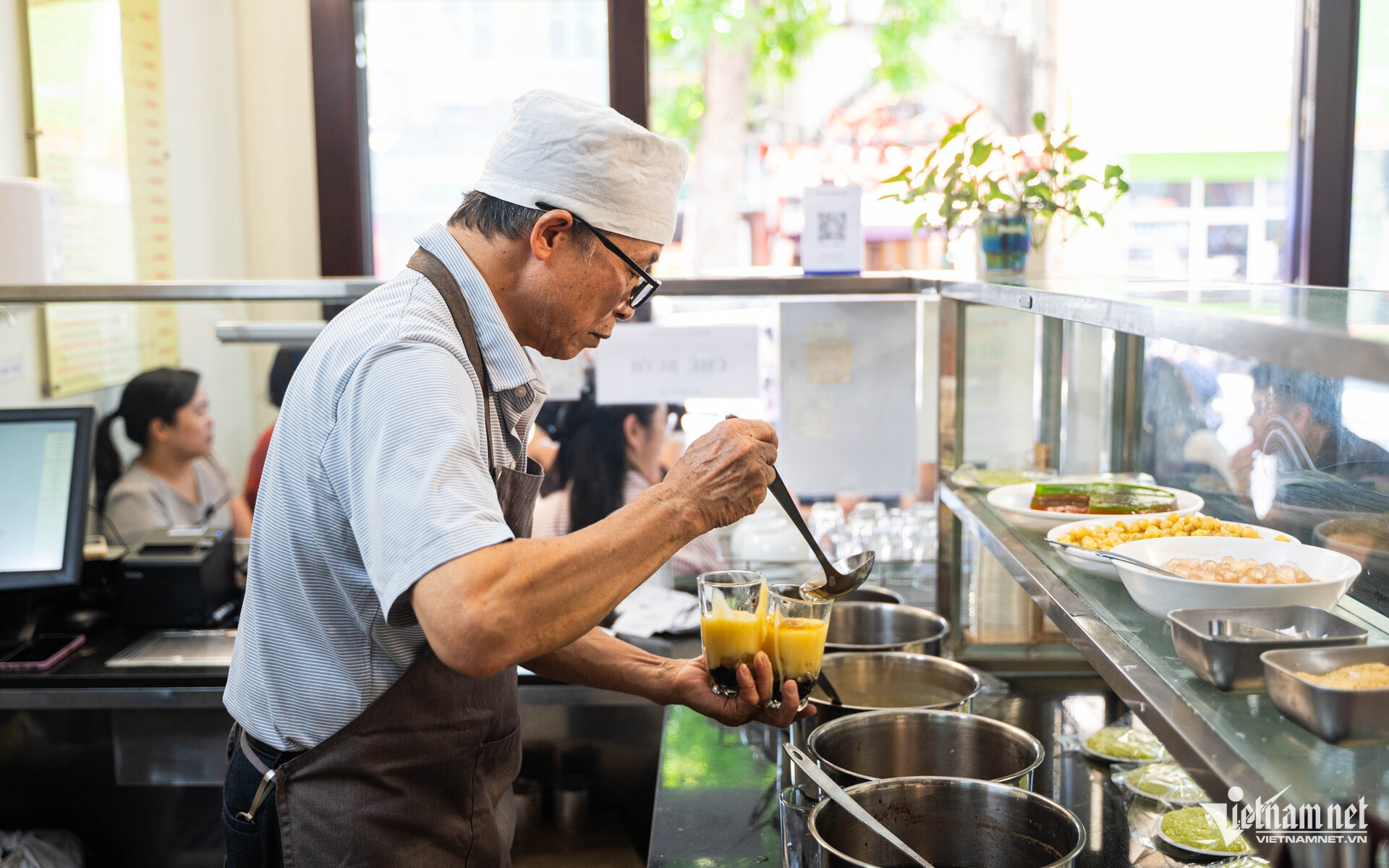
Inside the shiny stainless-steel counter displaying nearly 20 trays of ingredients such as black beans, mashed mung beans, tapioca pearls, lotus seeds, mung bean sticky rice, and grass jelly, Pham Xuan Thanh, born 1950, the owner of Che Muoi Sau on Lo Duc Street, Hanoim was quickly scooping portions of sweet soup for his customers.
More than 30 customers arrived at once, ordering dozens of different kinds of sweet soup, yet the almost 80-year-old owner remembers every order, while reminding his staff to add more ice, napkins, and arrange chairs for guests.
“I started helping my parents-in-law make sweet soup and later cooked and sold it with my wife. It’s been nearly 50 years. All work has become familiar, just by looking at the color of the beans, I can tell which ones will cook faster or take longer to soften,” Thanh shared.
The shop was first opened by Nguyen Thi Nghia Loc (Thanh’s mother-in-law), a talented Hanoi cook. Since the 1960s, she sold black bean and lotus seed sweet soup around the Old Quarter and Hom Market. In 1978, she and her children opened a shop at their home at No16 Ngo Thi Nham Street.
“In the past, people called it Che Ba Loc or Che Cho Hom because it didn’t have an official name. When we opened the shop, our family agreed on the name ‘Che Muoi Sau’ (Sweet Soup Sixteen), to remind people of our address, 16 Ngo Thi Nham, and to symbolize the age of sixteen — the age when almost everyone loves sweet soup.
“In the past, people called it Che Ba Loc or Che Cho Hom because it didn’t have an official name. When we opened the shop, our family agreed on the name ‘Che Muoi Sau’ (Sweet Soup Sixteen), to remind people of our address, 16 Ngo Thi Nham, and to symbolize the age of sixteen, the age when almost everyone loves sweet soup.
At one point, I even kept exactly 16 types of sweet soup on the menu to match the name,” Thanh recalled.
Since 1995 onward, the shop has become even more crowded. Customers fill the sidewalk or line up to buy takeout. Black bean, coconut lotus, mung bean, and sticky rice sweet soup, all traditional flavors, remain popular over the years, even as many new sweet soup shops appeared across the Old Quarter.
More than a year ago, Thanh and his wife opened a new branch on Lo Duc Street, while his wife’s younger sister continues running the original shop on Ngo Thi Nham Street.
Following Loc’s teachings, her children keep the traditional Hanoi-style sweet soups, avoiding modern market trends. “My mother told us that while business must be profitable, we must never sacrifice quality for greed,” Thanh said.
Currently, Thanh and his wife serve 18 traditional sweet soups and cakes, of which three dishes (che do den - hot black bean sweet soup, banh troi tau - black sesame glutinous rice balls, and che con ong - Vietnamese honeycomb-shaped pudding) available only in winter, and xoi vo gac (steamed momordica glutinous rice), sold only on the 1st and 15th days of each lunar month.
At 5 am every day, the couple and four staff members begin preparing sweet soups, sticky rice, and cakes. Thanh personally inspects ingredients delivered by trusted suppliers.
“Black beans must be round, full, unbroken, and green inside; mung beans must be yellow inside. Sticky rice must be the fragrant Nep Cai Hoa Vang variety grown along the Red River. For lotus seeds, I choose mature ones carefully peeled. During late summer, we use fresh lotus seeds; while for the rest of the year, we use dried ones,” Thanh explained.
According to him, making sweet soup today is much easier than before. When the shop first opened, the family soaked and cleaned beans by hand and cooked everything for hours on charcoal stoves. Now they use electric cookers and partially preprocessed ingredients, saving time and effort.
“Besides good ingredients, the key is mastering heat control so the beans are soft and aromatic without breaking apart. Each batch requires a different cooking time and sugar timing. It’s all about experience. The same goes for lotus seeds,” Thanh said.
While black beans are the dish needing longest simmering, pearls are the most elaborate to make, from mixing, kneading dough, cutting coconut to shaping each round pearl evenly then boiling.
"In the past my wife shaped pearls very skillfully. Later, she taught employees but we still check quality", he said.
The most difficult dish but also the shop's specialty is xoi vo gac. On the 1st or full moon days, Hanoi people often come from 6am to buy sticky rice for offerings.
Ha Nguyen
.svg)
